Ball mounts and drop hitches
Which fixed drop hitch matches your measured drop?
A drop hitch is a ball mount built for one specific measurement rather than a range, and it is the right purchase once you know your exact number rather than before. The whole point of getting the drop right is making the trailer frame level once hitched, because level keeps the tongue weight at the percentage you loaded for and keeps both trailer axles carrying their designed share of the load.
Get the height wrong and the consequence is not cosmetic. Tow nose high and the load shifts rearward onto the trailer axle, reducing tongue weight at the exact moment the trailer needs it most, because a light tongue is the condition that lets sway start and grow. Tow nose low and the load shifts forward instead, overloading the tow vehicle rear axle and the front trailer axle. Neither error announces itself with a warning light. It shows up as a trailer that feels twitchy behind a passing truck, or a truck that squats visibly at the back.
Measure with the tow vehicle loaded the way you actually tow, because a loaded truck sits lower than an empty one and the tolerance you are working within is about an inch. Once you have a real number, a fixed drop mount at a common stocked size, 2, 3 or 4 inches, is cheaper and simpler than an adjustable mount, and there is nothing to leave in the wrong position by accident.
On this page
- Beginner: pre-torqued and correct for a 2 inch coupler
- Intermediate: the size most travel trailers actually need
- Expert: when the measured drop is not a stocked fixed size
- Fixed drop hitches compared
- What if the trailer is not level once hitched?
- How do you find your exact number before buying anything?
Beginner: pre-torqued and correct for a 2 inch coupler
Both picks below arrive with the ball already torqued to the mount, which removes the single most commonly skipped step on a first hitch install.
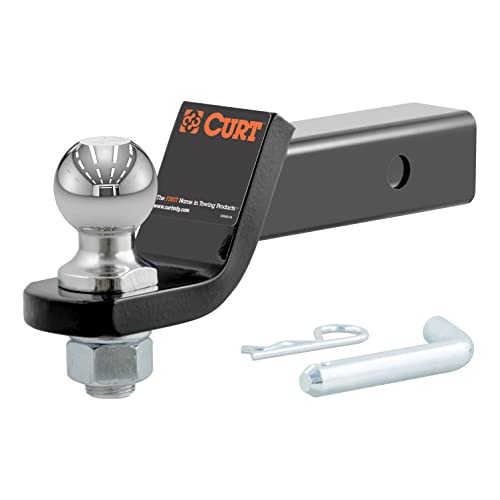
CURT 45036 Loaded Ball Mount, 7,500 lb, 2 inch drop
$31.99A 2 inch ball pre-torqued onto a 2 inch drop mount, rated 7,500 lb GTW and 750 lb tongue weight, at the lowest price on this page.
Best for: A measured 2 inch drop with a coupler stamped 2 inch.
Check price on AmazonIntermediate: the size most travel trailers actually need
Same fixed 2 inch drop, with the 2-5/16 inch ball that most travel trailer couplers are stamped for rather than the smaller utility trailer size.

CURT 45041 Class III Loaded Ball Mount with 2-5/16 inch Ball
$37.99A Class III mount with a 2-5/16 inch ball pre-torqued in place, which is the coupler size the majority of travel trailers on the road actually carry.
Best for: A travel trailer with a 2-5/16 inch coupler and a measured 2 inch drop requirement.
Check price on AmazonExpert: when the measured drop is not a stocked fixed size

CURT 45902 Adjustable Dual-Ball Channel Mount, 2-1/2 inch shank, 6 inch drop
$268.74 Published ratingsAn adjustable channel mount on a 2-1/2 inch Class V shank that flips for up to 6 inches of drop or 5-1/4 inches of rise, for the case where the fixed 2 inch options above do not land you within an inch of level.
Best for: A measured drop that falls between stocked fixed sizes, or a truck whose ride height changes between an empty and a loaded trip.
Check price on AmazonWho should not buy this tier: Anyone whose measured drop already matches a common fixed size like 2, 3 or 4 inches. Paying for adjustability and a bigger Class V shank when a $32 to $38 pre-torqued mount already gets you level is money spent solving a problem you do not have.
Fixed drop hitches compared
Both the CURT 45036 Loaded Ball Mount, 7,500 lb, 2 inch drop and CURT 45041 Class III Loaded Ball Mount with 2-5/16 inch Ball are fixed at a 2 inch drop; the CURT 45902 Adjustable Dual-Ball Channel Mount, 2-1/2 inch shank, 6 inch drop covers up to 6 inches of drop or rise for the cases those two do not fit.
Published standard A published, traceable figure: a standards body, a federal regulation or a manufacturer specification states it.
| Mount | Drop | Ball | GTW rating | Price |
|---|---|---|---|---|
| Reese Towpower Ball Mount, 2 inch receiver, 2 inch drop, 6,000 lb | 2 in, fixed | 2 in | 6,000 lb | $42.99 |
| CURT 45036 Loaded Ball Mount, 7,500 lb, 2 inch drop | 2 in, fixed | 2 in | 7,500 lb | $31.99 |
| CURT 45041 Class III Loaded Ball Mount with 2-5/16 inch Ball | 2 in, fixed | 2-5/16 in | 7,500 lb | $37.99 |
| CURT 45902 Adjustable Dual-Ball Channel Mount, 2-1/2 inch shank, 6 inch drop | Up to 6 in, adjustable | 2 and 2-5/16 in | 10,000 to 20,000 lb | $268.74 |
GTW figures are the mount own rating and are limited by whichever ball, shank or receiver in the assembly is rated lowest. Confirm your receiver rating separately.
What if the trailer is not level once hitched?
Nose high moves load onto the trailer axle and reduces tongue weight, which is the condition that lets sway start.
Rule of thumb Widely taught towing convention rather than a published specification. It is a good starting point and it is not a rating.
| Trailer attitude | What happens to tongue weight | Fix |
|---|---|---|
| Nose high | Falls, load shifts onto the trailer axle | You need more drop, or a shorter shank on a rise mount |
| Nose low | Rises, load shifts onto the tongue and front trailer axle | You need less drop, or a rise instead |
| Level, within about 1 inch | Matches what you loaded for | The mount you have is correct |
The 1 inch tolerance is towing convention taught by hitch makers rather than a published standard. It is a reliable practical target regardless.
How do you find your exact number before buying anything?
- Load the truck the way you tow. Passengers, cargo and fuel included. This is the step most often skipped, and it is the one that determines whether the number you get is real.
- Measure the receiver opening height. Ground to the top inside edge, on level pavement.
- Measure the coupler at level. Ground to the bottom of the coupler, with the trailer frame sitting level on its jack.
- Subtract to get drop or rise. A taller receiver measurement means you need a drop of the difference. A taller coupler measurement means you need a rise.
- Buy to the number, not to a guess. A fixed mount at the nearest common stocked size handles most cases. If your number sits well between stocked sizes, an adjustable mount removes the guesswork entirely.
How we chose
We did not test this hardware in person and we never claim to. Picks are researched from manufacturer specification sheets, published towing standards, and the recurring themes in verified owner reviews. Every pick is matched to a real gross trailer weight rating, a real tongue or pin weight rating, a real receiver size or a real load index rather than to a price bracket, and it is placed in the tier where its published capability actually belongs. We rejected the unbranded flood that dominates the search results in several of these categories, because a weight distribution hitch, a brake controller, a trailer tire and a set of safety chains are all parts whose failure puts a loose trailer on a public road. Where a figure is towing convention rather than a published standard we label it that way, and where a manufacturer does not publish a figure we leave it out instead of estimating it.
Frequently asked questions
What is the difference between a drop hitch and a rise hitch?
They are the same part used in opposite directions. A drop lowers the ball below the receiver opening, needed when the receiver sits higher than the coupler at level. A rise raises the ball above the receiver, needed when the coupler sits higher. Many mounts, including several in this catalog, are reversible and give you both from one part depending on which way it is installed.
How do I know if I need a 2 inch drop or something else?
Measure your receiver opening height and your coupler height at level, both with the tow vehicle loaded the way you tow, then subtract. If the receiver sits exactly 2 inches above the coupler, a 2 inch drop mount is correct. Any other difference calls for the nearest stocked size or an adjustable mount if the number falls between them.
Why does the tow vehicle need to be loaded when I measure?
Because a loaded truck sits measurably lower than an empty one, and the tolerance for level towing is about 1 inch total. Measuring an empty truck in the driveway and buying a fixed mount to that number is one of the most common reasons an otherwise correctly purchased hitch still tows nose high once passengers and cargo are aboard.
Is a pre-torqued loaded ball mount actually better than buying the parts separately?
For most buyers, yes, because torquing the ball nut correctly is the single most commonly skipped step on a new hitch, and a loaded mount arrives with it already done to spec. Buying separately only makes sense if you need a ball size, shank length or rating that no loaded kit offers, and you already own a torque wrench rated for the job.
When should I buy an adjustable mount instead of a fixed drop hitch?
When your measured number falls between common stocked sizes, when you tow more than one trailer with different coupler heights, or when your truck ride height changes meaningfully between empty and loaded. A fixed mount is cheaper and simpler once you have one confirmed number that will not change.
Does a higher GTW rating on the ball mount mean it is safer?
Only up to the point where every other part in the chain, the receiver, the ball itself and the shank, is rated to match. The assembled hitch is limited by whichever component is rated lowest, so buying the highest rated ball mount available does not raise what your specific receiver or vehicle can actually carry.
Free download
Get the complete tow rig setups emailed to you
Both ladders, conventional travel trailer and fifth wheel, at beginner, intermediate and expert budgets, every item priced and linked with a running total, plus a printable pre-trip weighing worksheet you can fill in at the scale.
One email with the setups. No sequence, no sharing your address, unsubscribe any time.
Researched, not professional advice. This page is compiled from published standards, manufacturer towing guides and product specifications, and owner-review consensus, not hands-on testing. Figures described as a rule of thumb are towing convention rather than published standards, and they are labelled that way wherever they appear. Nothing here overrides your own ratings. Work your payload sum before your tow rating, because payload is the limit that actually binds on most half ton trucks and nearly every SUV. Load a conventional trailer to 10 to 15 percent tongue weight and a fifth wheel to 15 to 25 percent pin weight, and never lighter: a tail heavy trailer is what starts sway. Weigh the rig loaded rather than trusting a brochure dry weight. A weight distribution hitch and a set of air bags both restore ride height and control, and neither one raises a single rating. Trailer brakes are required by state law above a threshold that varies by state, and a breakaway battery that has quietly gone flat is the normal condition of most trailers on the road.