Fifth wheel hitches
Puck system or rail mounted fifth wheel hitch: what actually comes in the box?

B&W Companion OEM Puck Fifth Wheel Hitch for Ford, 25,000 lb
$1,399.00 Published ratingsBolts straight into the Ford factory puck pattern with no rails and no drilling, a complete install on a truck that already has the prep package.
Best for: A Ford Super Duty with the factory puck system.
Check price on Amazon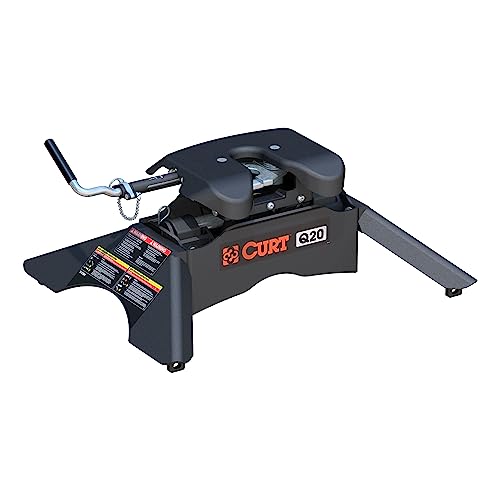
CURT Q20 Fifth Wheel Hitch, 20,000 lb
$599.99Ships as the head alone; base rails and vehicle-specific installation brackets are both sold separately to complete the install.
Best for: A mid to large fifth wheel where ride quality matters.
Check price on AmazonThe real difference between a puck system and a rail mounted fifth wheel hitch is not the head itself, it is everything the head needs underneath it before it can be bolted to a truck. A puck system head threads directly into factory-installed inserts set into the bed floor over the frame, and if the truck was ordered with that prep package, nothing else needs to be bought or installed. B&W Companion OEM Puck Fifth Wheel Hitch for Ford, 25,000 lb is a straightforward example: it drops into the Ford factory puck pattern with no rails and no drilling at all.
A rail mounted hitch has no equivalent factory prep to rely on. CURT Q20 Fifth Wheel Hitch, 20,000 lb ships as the hitch head alone, and its own listing says plainly that base rails and installation brackets are sold separately. That is not a hidden cost, it is standard for the entire rail mounted category, and a buyer who orders only the head will open the box to a hitch they cannot yet install.
What actually has to be bought to finish each install?
A puck system on a prepped truck needs one purchase, the head. A rail mounted hitch needs three: the head, base rails, and vehicle-specific brackets.
Rule of thumb Widely taught towing convention rather than a published specification. It is a good starting point and it is not a rating.
| Puck system (on a prepped truck) | Rail mounted | |
|---|---|---|
| Hitch head | Required, one purchase | Required, one purchase |
| Base rails | Not needed | Required, sold separately |
| Vehicle-specific installation brackets | Not needed | Required, sold separately |
| Drilling typically required | No | Sometimes, depending on the specific bracket kit |
| Total separate purchases to complete install | 1 | 3 |
This assumes the truck already has the factory puck pattern for the puck system side. A truck without it cannot use a puck hitch at all, regardless of price.
What is a puck system, mechanically?
A puck system is a set of factory-installed, threaded inserts set into the bed floor directly over the truck's frame, capped with rubber plugs when nothing is hitched. A compatible hitch's legs bolt straight into those inserts. It is a factory tow package option, not something every truck has: B&W Companion OEM Puck Fifth Wheel Hitch for Ford, 25,000 lb fits the Ford pattern specifically, B&W Companion OEM Puck Fifth Wheel Hitch for Chevrolet and GMC, 20,000 lb and B&W Companion OEM Puck Fifth Wheel Hitch for Chevrolet and GMC, 25,000 lb fit the GM pattern, and CURT A20 Fifth Wheel Hitch for GM Puck System, 20,000 lb and CURT A25 Fifth Wheel Hitch for GM Puck System, 25,000 lb are CURT's own puck-mounted heads for the GM pattern at two different ratings. None of these interchange between brands, because the puck spacing and thread pattern differ by manufacturer.
What does a rail mounted install actually require?
Three separate parts, bought as three separate purchases in most cases. First, the head itself, such as CURT Q20 Fifth Wheel Hitch, 20,000 lb. Second, base rails that run the width of the frame, such as CURT 16204 Universal Fifth Wheel Base Rails, 25,000 lb or the equivalent CURT 16104 Industry-Standard Fifth Wheel Hitch Rails, 25,000 lb, rated at 25,000 lb and fitting nearly any rail mounted fifth wheel or gooseneck hitch on the market, which is why rails frequently outlive the hitch bolted to them. Third, vehicle-specific installation brackets that carry the rails into the truck's own frame, such as CURT 16432 Fifth Wheel Installation Brackets for Ford Super Duty, built specifically for the Ford Super Duty frame and not interchangeable with another truck's bracket kit.
CURT A16 Fifth Wheel Hitch with Rails, 16,000 lb is the one notable exception in this catalog: it ships with rails included as part of the kit, which is worth checking for specifically if a single-purchase rail mounted install is what you actually want.
Which one actually costs less, once everything is accounted for?
It depends entirely on what the truck already has, not on which category is inherently cheaper. If a truck already has the factory puck pattern, the head is the only purchase needed, which is the cheapest possible outcome for that specific truck since there is no rail or bracket cost to add. If a truck has no puck pattern at all, puck hitches are not an option regardless of price, and the rail mounted path, head plus rails plus brackets, is the only route available.
Comparing a rail mounted total against a puck head price only makes sense when both are actually available on the same truck, which is rare, since most trucks either have the factory prep or do not. Check what your specific truck came with before pricing either path.
Frequently asked questions
How do I know if my truck has a factory puck system?
Look for rubber-capped inserts set into the bed floor directly over the frame rails, typically in a rectangular pattern near the tailgate end of the bed. Your truck's original tow package documentation or window sticker will also list it if it was ordered with the prep package. If the bed floor is smooth with no covered inserts, the truck does not have it.
Can I install a puck pattern on a truck that does not have one?
Not with the products in this catalog, which are hitch heads built to bolt into an existing factory pattern rather than to create one. A truck without factory pucks needs the rail mounted path instead: a head, base rails, and vehicle-specific brackets that bolt into the frame the truck actually has.
Do all puck-mounted hitches fit all puck systems?
No, puck spacing and thread pattern are brand specific. B&W Companion OEM Puck Fifth Wheel Hitch for Ford, 25,000 lb fits Ford's pattern, B&W Companion OEM Puck Fifth Wheel Hitch for Chevrolet and GMC, 25,000 lb fits GM's, and buying the wrong brand's puck hitch for your truck's actual pattern will not bolt on regardless of how similar the two hitches look in a listing.
Is drilling ever required with a rail mounted install?
Sometimes, depending on the specific bracket kit and truck combination. Some bracket kits, like CURT 16432 Fifth Wheel Installation Brackets for Ford Super Duty for Ford Super Duty, bolt into existing frame holes; others require drilling new holes. Check the exact bracket kit's own installation instructions for your specific truck rather than assuming either outcome.
Can base rails be reused if I switch to a different hitch brand later?
Often yes. CURT 16204 Universal Fifth Wheel Base Rails, 25,000 lb is described as industry standard, fitting nearly every rail mounted fifth wheel and gooseneck hitch on the market, which is why rails frequently outlive the specific hitch head bolted to them. Confirm the new head's own compatibility list against your existing rails before assuming a swap will work.
Is a puck system always cheaper than a rail mounted setup?
Only when the truck already has the factory puck pattern, in which case the head is the sole purchase needed. A truck without that pattern cannot use a puck hitch at any price, making the rail mounted path, head plus rails plus brackets, the only option regardless of cost, so the comparison only applies when both paths are genuinely available.
Free download
Get the complete tow rig setups emailed to you
Both ladders, conventional travel trailer and fifth wheel, at beginner, intermediate and expert budgets, every item priced and linked with a running total, plus a printable pre-trip weighing worksheet you can fill in at the scale.
One email with the setups. No sequence, no sharing your address, unsubscribe any time.
Researched, not professional advice. This page is compiled from published standards, manufacturer towing guides and product specifications, and owner-review consensus, not hands-on testing. Figures described as a rule of thumb are towing convention rather than published standards, and they are labelled that way wherever they appear. Nothing here overrides your own ratings. Work your payload sum before your tow rating, because payload is the limit that actually binds on most half ton trucks and nearly every SUV. Load a conventional trailer to 10 to 15 percent tongue weight and a fifth wheel to 15 to 25 percent pin weight, and never lighter: a tail heavy trailer is what starts sway. Weigh the rig loaded rather than trusting a brochure dry weight. A weight distribution hitch and a set of air bags both restore ride height and control, and neither one raises a single rating. Trailer brakes are required by state law above a threshold that varies by state, and a breakaway battery that has quietly gone flat is the normal condition of most trailers on the road.