Transmission cooling
Which transmission cooler should you add before towing?
Fluid breakdown, not mileage, is what ends most automatic transmissions early. Automatic transmission fluid oxidizes and loses its friction properties as it gets hotter, and the single hottest moment a transmission will ever see in normal use is a long, sustained grade climb at towing weight, where the torque converter slips continuously to keep the engine in its power band. A factory cooler sized for an unloaded commute is frequently not sized for that load.
An auxiliary cooler adds surface area in the airflow ahead of the radiator, and the core design matters as much as the size. A stacked plate core moves substantially more heat than a tube-and-fin core of the same frontal area, which is why the picks below favor stacked plate designs once you are past the cheapest entry point. None of this replaces reading the temperature gauge on the climb itself; a cooler buys margin, it does not remove the need to manage the grade.
Work out the actual climb you are dealing with using the grade descent calculator and the grade and descent gear chart before deciding how much cooler you need. A truck that only ever tows on flat interstate has a very different heat problem than one that regularly climbs a mountain pass.
On this page
- Why does towing kill transmissions that never gave trouble before?
- How we chose these coolers
- Beginner: the cheapest correct fix
- Intermediate: the buy-once pick
- Expert: the performance ceiling
- How do these coolers compare on paper?
- Do you need an auxiliary cooler if your truck already has a tow package?
- Where does the heat actually come from on a climb?
Why does towing kill transmissions that never gave trouble before?
An automatic transmission generates most of its own heat internally, through fluid friction in the torque converter and the clutch packs, and normal driving keeps that heat within what the factory cooler was designed to shed. Add a loaded trailer and a long climb, and the torque converter spends minutes at a time slipping rather than locked up, which is exactly the condition that generates the most heat per mile. The fluid that carries that heat away is also the fluid doing the shifting, so once it degrades from sustained high temperature, shift quality and clutch life both suffer along with it.
The factory cooler on many half ton and mid size trucks is sized for the transmission's own cooling needs at typical highway load, not for towing near the vehicle's rated capacity on a real grade. An auxiliary cooler in series with the factory unit adds the margin that towing removes.
How we chose these coolers
We did not install any of these coolers ourselves. Every pick comes from the manufacturer's own published core design, fitment and rating, checked against the consensus of verified owner reviews on the listing itself.
Beginner: the cheapest correct fix
The lowest total cost to real cooling margin, or to a working cooler where the factory one has failed.

Hayden Automotive Rapid-Cool Add-On Transmission Cooler
$55.95The cheapest credible auxiliary cooler here, from a maker that has supplied this category for decades. Hayden describes it as an add-on unit that goes in series with the existing cooler rather than a replacement for it.
Check before buying: Hayden states this is an add-on cooler rather than a direct replacement for the factory unit, so it goes in series with what is already there.
Best for: A first auxiliary cooler on a half ton truck that already has a working factory cooler.
Check price on Amazon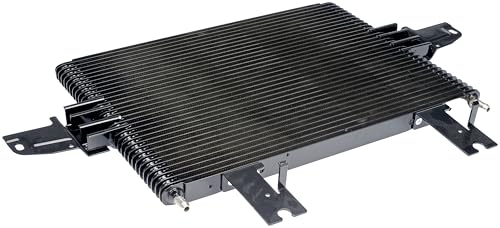
Dorman Automatic Transmission Oil Cooler for Ford
$219.78A direct-fit replacement cooler for select Ford trucks, which is the correct purchase when the factory cooler itself has failed from heat, corrosion or damage rather than when the goal is more capacity than stock.
Best for: Replacing a failed factory cooler on select Ford trucks rather than adding a second one.
Check price on AmazonIntermediate: the buy-once pick
Universal fit, real capacity, and enough core to matter on a genuine grade climb.

Mishimoto Universal 13-Row Stacked Plate Transmission Cooler Kit
$159.95Thirteen rows of stacked plate core in a universal mounting kit that fits ahead of nearly any radiator, with a 40,000 lb GVW rating published in the listing.
Best for: Any tow vehicle that climbs real grades with a loaded travel trailer or fifth wheel behind it.
Check price on AmazonExpert: the performance ceiling
A direct fit rather than a universal kit, for a truck that tows heavy and often.

Mishimoto Transmission Cooler for Ram 2500 to 5500 Cummins
$556.11A bolt-in fit for select Ram Cummins trucks removes the bracket fabrication and hose routing guesswork of a universal install, and the 48-row stacked plate core is a published 212 percent increase in core volume over the factory cooler it replaces, with a serviceable thermostat and bypass rather than the failure-locked-closed design of the original part.
Best for: A heavy diesel tow rig used for towing near its rated capacity on a regular basis.
Check price on AmazonWho should not buy this tier: Skip this tier if your truck did not come with, or does not fit, this direct application, or if you tow occasionally and lightly. The Mishimoto 13-row universal kit above covers nearly every other tow vehicle at a fraction of the price and effort.
How do these coolers compare on paper?
Every figure below is the manufacturer's own published description from the current listing.
The direct-fit Cummins cooler claims a published 212 percent increase in core volume over the factory part it replaces, the largest single figure on this page.
Published standard A published, traceable figure: a standards body, a federal regulation or a manufacturer specification states it.
| Cooler | Core type | Published capacity |
|---|---|---|
| the Hayden Rapid-Cool add-on cooler | Tube and fin, add-on | GVWR up to 24,000 lb, towing up to 5,000 lb |
| Mishimoto Universal 13-Row Stacked Plate Transmission Cooler Kit | Stacked plate, 13-row | 40,000 lb GVW rating |
| the direct-fit Cummins cooler | Stacked plate, 48-row | 212 percent more core volume than the factory cooler it replaces |
| the direct-fit Ford replacement cooler | OEM-style replacement | Not published beyond matching original function |
"Not published" means the maker did not state a numeric rating in its own listing. Matching factory fit and function is the stated goal for that part instead.
Do you need an auxiliary cooler if your truck already has a tow package?
Frequently, yes, if the towing is heavy and regular. A factory tow package on many trucks already includes an upgraded cooler over the base transmission, and that cooler is genuinely adequate for most owners most of the time. Where it runs out of margin is a truck used near its rated capacity on a repeated basis, especially climbing long grades in hot weather, which is the specific condition an auxiliary cooler is bought to cover. Read the guide to towing down a long grade for the descent side of the same trip, since a transmission works hard holding a lower gear on the way down too.
Where does the heat actually come from on a climb?
Mostly from the torque converter, not from the engine or the road surface. On a flat highway the converter locks up and the transmission behaves almost like a mechanical connection, generating very little heat of its own. On a sustained climb at towing weight, the engine needs to stay in a usable RPM range, and the converter slips to allow that, converting the difference into heat inside the fluid itself. Manually selecting a lower gear, described in our guide to towing with a half ton truck, reduces how long the converter has to slip to hold speed, which reduces heat generated at the source rather than only removing it faster once it exists.
The same logic applies across a heavier class of truck too. See the half ton against three quarter ton comparison for how much of that margin comes from a bigger factory cooling package rather than from the engine alone.
How we chose
We did not test this hardware in person and we never claim to. Picks are researched from manufacturer specification sheets, published towing standards, and the recurring themes in verified owner reviews. Every pick is matched to a real gross trailer weight rating, a real tongue or pin weight rating, a real receiver size or a real load index rather than to a price bracket, and it is placed in the tier where its published capability actually belongs. We rejected the unbranded flood that dominates the search results in several of these categories, because a weight distribution hitch, a brake controller, a trailer tire and a set of safety chains are all parts whose failure puts a loose trailer on a public road. Where a figure is towing convention rather than a published standard we label it that way, and where a manufacturer does not publish a figure we leave it out instead of estimating it.
Frequently asked questions
Does towing really damage a transmission that never overheated before?
Yes, and it often happens quietly. Fluid breaks down from sustained high heat well before a warning light appears, and a long grade climb at towing weight is the single hottest condition most transmissions ever see. The damage shows up later as rough shifting or clutch wear, not as an immediate failure on the climb itself, which is why the cause is easy to miss.
What is the difference between a stacked plate and a tube and fin cooler?
A stacked plate core uses thin, stacked layers with internal turbulators to move fluid past a large surface area, while a tube and fin core routes fluid through round or oval tubes with fins bonded on for airflow. For the same frontal size, a stacked plate design moves substantially more heat, which is why most upgrade coolers use that design rather than the cheaper tube and fin layout.
Do I need an auxiliary cooler if my truck already has a tow package?
Often not for light or occasional towing, since a factory tow package usually includes an upgraded cooler already. It becomes worth adding when towing is heavy, frequent, or done on real grades in hot weather, because that is the specific condition where even an upgraded factory cooler can run out of margin.
Can an auxiliary cooler make the transmission run too cold?
It is uncommon, because most add-on coolers work in series with the factory cooler rather than replacing its regulation. Some direct-fit coolers, including the Ram Cummins cooler in this roundup, include a serviceable thermostat and bypass specifically to route fluid around the cooler until it warms up, which addresses this concern by design rather than by luck.
Is a universal cooler as good as a direct fit one?
A universal cooler with a genuine stacked plate core moves heat just as well per square inch as a direct fit part, but a direct fit cooler removes the guesswork in mounting position, airflow and hose routing that a universal install leaves up to the installer. Pay for direct fit when the specific application exists; buy a well reviewed universal kit when it does not.
What should I actually watch while climbing a long grade with a trailer?
The transmission temperature gauge if the vehicle has one, and the behavior of the engine and transmission together rather than a fixed number. A gauge that climbs and then holds steady is normal; one that keeps climbing without leveling off means to downshift, slow down, or pull over. The owner's manual for your specific vehicle is the authority on any published temperature threshold.
Free download
Get the complete tow rig setups emailed to you
Both ladders, conventional travel trailer and fifth wheel, at beginner, intermediate and expert budgets, every item priced and linked with a running total, plus a printable pre-trip weighing worksheet you can fill in at the scale.
One email with the setups. No sequence, no sharing your address, unsubscribe any time.
Researched, not professional advice. This page is compiled from published standards, manufacturer towing guides and product specifications, and owner-review consensus, not hands-on testing. Figures described as a rule of thumb are towing convention rather than published standards, and they are labelled that way wherever they appear. Nothing here overrides your own ratings. Work your payload sum before your tow rating, because payload is the limit that actually binds on most half ton trucks and nearly every SUV. Load a conventional trailer to 10 to 15 percent tongue weight and a fifth wheel to 15 to 25 percent pin weight, and never lighter: a tail heavy trailer is what starts sway. Weigh the rig loaded rather than trusting a brochure dry weight. A weight distribution hitch and a set of air bags both restore ride height and control, and neither one raises a single rating. Trailer brakes are required by state law above a threshold that varies by state, and a breakaway battery that has quietly gone flat is the normal condition of most trailers on the road.