Weights and capacities
Will that truck camper fit your payload?
This is the place where trusting a brochure number does the most damage, because nothing is towed and nothing is hitched: the entire load sits on the truck, and the only thing standing between you and an overloaded vehicle is arithmetic.
There is a second constraint that has nothing to do with weight. The camper centre of gravity has to sit forward of the truck rear axle. Every camper has its CG marked, and every truck maker publishes a permitted CG zone. A camper whose CG lands behind the rear axle unloads the steer axle and the truck becomes unsteerable long before anything breaks.
Work the payload sum
Over payload by 904 lb. Air bags will level it and will not fix it.
| Figure | Value |
|---|---|
| Water weight | 334 lb |
| Wet, equipped camper | 3,544 lb |
| Plus passengers | 3,904 lb |
| Payload rating | 3,000 lb |
| Remaining | -904 lb |
Shown with the example figures above. Change any field to run your own numbers.
The working
From your own vehiclewet camper = dry weight + options + water + propane + batteries + gear used = wet camper + passengers remaining = truck payload rating - used
The payload rating is a vehicle-specific figure from your own door jamb sticker. This number exists only on your own vehicle and trailer. Read it off the door jamb sticker, the trailer certification label or the owner manual.
Tie downs and suspension
Four turnbuckles are the only thing holding the camper to a moving truck. Helper springs level a squatting truck and raise no rating at all.
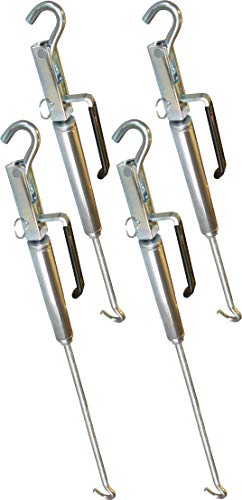
HappiJac Qwik-Load Turnbuckles for Truck Camper Tie Down
$409.16Spring loaded, so the tension stays constant as the truck and camper flex against each other instead of cycling the hardware loose on rough road.
Best for: A camper that goes down forest roads rather than only to campgrounds.
Check price on Amazon
Air Lift 1000 HD Air Spring Kit for Ram 1500
$213.99The heavy duty version of the same kit, with a higher maximum inflation pressure and more support at the top of the range.
Best for: A Ram 1500 towing near the top of its payload.
Check price on Amazon
HappiJac Standard Turnbuckle Replacement Set, 25.5 inch
$166.79HappiJac is the tie down system most truck campers were built around, so this is a replacement rather than a conversion. Turnbuckles corrode and stretch, and they are inspected far less often than they should be.
Best for: Replacing tired turnbuckles on a HappiJac equipped camper.
Check price on Amazon
Air Lift 1000 Air Spring Kit for Ram 1500
$149.99Adjustable air springs inside the rear coils, so the ride height can be set for the load and dropped back down when the trailer is off. Air Lift publishes vehicle specific fitment rather than selling a universal kit.
Check before buying: Air springs level the truck. They do not add payload capacity, they do not change the GVWR and they do not change the rear axle GAWR. Nothing in this category does.
Best for: A Ram 1500 that squats with a heavy tongue weight.
Check price on Amazon
Air Lift 1000 Air Spring Kit for Toyota 4Runner and Lexus GX460
$149.99SUVs squat harder than trucks under the same tongue weight because they have less rear spring and a shorter wheelbase. This is the fit for a 4Runner or GX460.
Best for: Towing a small trailer with a 4Runner or GX460.
Check price on Amazon
HappiJac Replacement Standard Threaded Turnbuckle with 24 inch Hook
$75.45A single fully adjustable turnbuckle, for replacing one that has seized rather than buying a whole set.
Best for: Replacing one failed turnbuckle.
Check price on AmazonEvery rating shown is the manufacturer's own published figure. The rating on the part you receive is what governs, and your own door jamb sticker governs everything above it.
What dry weight leaves out
Every item below is excluded from the advertised dry weight on most campers, and every one of them comes out of your payload.
Fresh water alone at 8.34 lb per gallon turns a 40 gallon tank into 334 lb.
Rule of thumb Widely taught towing convention rather than a published specification. It is a good starting point and it is not a rating.
| What | Typical weight |
|---|---|
| Factory options and upgrades | 200 to 600 lb |
| Fresh water, 40 gallons | 334 lb |
| Grey and black tanks on the way home, 30 gallons | 250 lb |
| Two batteries | 100 to 130 lb |
| Propane, two cylinders | 74 lb |
| Jacks, if not included | 100 to 150 lb |
| Gear, bedding, food, tools | 300 to 600 lb |
| Passengers | 180 lb each |
Typical ranges rather than published figures. Weigh the loaded truck at a public scale, which is the only way to know, and check the individual axle weights while you are there.
The centre of gravity constraint
Weight is only half the problem. Look for two things:
- The CG marking on the camper, usually a sticker or a stamped mark on the side, showing where its centre of gravity sits relative to its own floor length.
- The permitted CG zone for your truck, published by the manufacturer, expressed as a distance from the rear axle centreline forward.
The camper CG must land inside that zone. If it lands behind the rear axle, the camper acts as a lever lifting the front of the truck, which takes weight off the steer axle and off the front brakes. The truck will feel light and vague at the front, and it gets worse as you add water and gear, which are usually rearward.
What air bags do and do not do
A truck carrying a camper will squat, and air bags or helper springs will level it and improve the ride and the headlight aim. That is worth having.
They do not raise your payload, your GVWR or your rear axle GAWR. A truck sitting level while 500 lb over its payload rating is still 500 lb over, and the visual cue that something was wrong has been removed. Work this sum first, then fit the bags because you want the ride.
Frequently asked questions
Why is truck camper dry weight misleading?
Because it excludes almost everything that makes the camper usable: factory options, the battery, propane, fresh water, the jacks on many models, and everything you put inside. A wet, equipped camper is routinely 800 to 1,200 lb heavier than the advertised figure, and every pound of that difference comes out of your truck payload.
Where does the camper centre of gravity need to be?
Forward of the truck rear axle, inside the permitted CG zone your truck manufacturer publishes. Every camper has its CG marked on the side. If the CG lands behind the rear axle, the camper acts as a lever lifting the front of the truck, which unloads the steer axle and the front brakes and makes the truck vague and unsafe to steer.
Is a truck camper a towing problem or a payload problem?
Purely a payload problem, which is what makes it different from every other page on this site. Nothing is hitched and nothing is towed. The entire camper sits on the truck, so the tow rating is irrelevant and the payload figure on your yellow door jamb sticker is the only number that matters, along with the rear axle GAWR.
Do air bags let me carry a heavier camper?
No. Air bags and helper springs level a squatting truck and improve the ride and headlight aim, which is genuinely worth having. They change nothing about the payload rating, the GVWR or the rear axle GAWR. An overloaded truck sitting level is still overloaded, and the one visible cue that something was wrong has been removed.
How do I weigh a truck camper properly?
Drive the fully loaded truck with the camper mounted onto a public scale and get individual axle weights rather than just a total. The rear axle figure is the one that catches people, because a camper concentrates its load there and can exhaust the rear GAWR while the truck is still inside its GVWR.
How often should I check the tie downs?
Before every trip, and properly rather than glancing at them. Four turnbuckles are the only thing holding a camper weighing a ton or more to a moving truck. They corrode where you cannot see, they stretch under repeated load, and a set that has lived in weather for several seasons should be replaced rather than inspected hopefully.
Free download
Get the complete tow rig setups emailed to you
Both ladders, conventional travel trailer and fifth wheel, at beginner, intermediate and expert budgets, every item priced and linked with a running total, plus a printable pre-trip weighing worksheet you can fill in at the scale.
One email with the setups. No sequence, no sharing your address, unsubscribe any time.
Researched, not professional advice. This page is compiled from published standards, manufacturer towing guides and product specifications, and owner-review consensus, not hands-on testing. Figures described as a rule of thumb are towing convention rather than published standards, and they are labelled that way wherever they appear. Nothing here overrides your own ratings. Work your payload sum before your tow rating, because payload is the limit that actually binds on most half ton trucks and nearly every SUV. Load a conventional trailer to 10 to 15 percent tongue weight and a fifth wheel to 15 to 25 percent pin weight, and never lighter: a tail heavy trailer is what starts sway. Weigh the rig loaded rather than trusting a brochure dry weight. A weight distribution hitch and a set of air bags both restore ride height and control, and neither one raises a single rating. Trailer brakes are required by state law above a threshold that varies by state, and a breakaway battery that has quietly gone flat is the normal condition of most trailers on the road.