Trailer wheels and hubs
How tight should trailer lug nuts actually be?
A trailer wheel that comes off at highway speed is a projectile, and the two things that put a wheel there are lug nuts torqued to the wrong value and lug nuts never re-checked after the wheel beds in. Neither failure requires bad parts. Both are entirely preventable with a torque wrench and a five minute re-check.
Lug nut torque is not one number. It depends on the stud diameter and thread pitch, and beyond that, different axle manufacturers publish somewhat different figures even at the same nominal stud size, because wheel and hub design details vary between brands. The ranges below are widely published and repeated across the trailer parts industry, and they are labelled as convention for exactly that reason: they are a reliable starting point, not a specification you should treat as gospel over your own axle's documentation.
The axle manufacturer's specification is the authority. It is usually printed on a sticker on the axle itself, or stated in the trailer's owner documentation or on the wheel manufacturer's own spec sheet. When the two disagree, follow the number that came with your specific axle and wheel, not the range on this page.
On this page
- What torque range does each stud size typically call for?
- Why can't this page give you one exact number?
- How do you actually tighten trailer lug nuts?
- Why is the 50 mile re-check mandatory rather than optional?
- How do you torque and re-check trailer lug nuts step by step?
- A first torque wrench for trailer wheels
What torque range does each stud size typically call for?
A 9/16 inch stud, common on 3,500 to 6,000 lb axles, typically calls for 120 to 140 ft-lb, a widely repeated range rather than a single enforced standard.
Rule of thumb Widely taught towing convention rather than a published specification. It is a good starting point and it is not a rating.
| Stud size | Typical torque range | Where it commonly appears |
|---|---|---|
| 1/2 in | 90 to 120 ft-lb | Lighter axles, commonly seen on trailers up to about 3,500 lb |
| 9/16 in | 120 to 140 ft-lb | Mid-weight axles, commonly seen from about 3,500 to 6,000 lb |
| 5/8 in | 140 to 160 ft-lb | Heavier axles, commonly seen at 6,000 lb and above |
These ranges are widely published across the trailer parts industry and repeated by torque wrench and wheel makers as a general reference, not a single specification issued by one standards body. Torque values also differ between lubricated and dry threads and between different wheel and hub designs at the same stud size. Your own axle manufacturer's specification, on the axle sticker or in the trailer's documentation, is the number to follow.
Why can't this page give you one exact number?
Lug nut torque has to clamp the wheel tightly enough that it cannot work loose under the cyclic load of driving, without stretching the stud past its elastic limit, which would weaken it permanently. That balance point depends on the stud's exact diameter and thread pitch, the wheel's contact surface design, whether the threads are lubricated or dry, and the hub and axle design behind it. Two axles with what looks like the same size stud can specify meaningfully different torque, because "the same size" by eye is not the same as "the same design" by engineering.
A universal table that ignored all of that would look confident and would occasionally be wrong in a way nobody would catch until a wheel came loose. That is the exact failure mode this site refuses to publish elsewhere on capacity and load figures, and it applies here with the same weight: a plausible-looking wrong number in a load-bearing table is more dangerous than admitting the number varies. Check the sticker on your own axle before trusting any chart, including this one.
How do you actually tighten trailer lug nuts?
Lug nuts are tightened in a star or crisscross pattern, in three stages, never straight around the circle and never to full torque on the first pass.
Rule of thumb Widely taught towing convention rather than a published specification. It is a good starting point and it is not a rating.
| Stage | What to do | Why |
|---|---|---|
| Stage 1 | Snug every lug nut by hand or with a low-torque pass, following a star pattern rather than going around the circle in order | Seats the wheel evenly against the hub before any real clamping force is applied |
| Stage 2 | Torque to roughly half the target value, still in the star pattern | Draws the wheel down evenly, avoiding the warping that comes from fully tightening one side before touching the others |
| Stage 3 | Torque to the full target value, in the star pattern, checking each nut once more at the end | Final, even clamping force across the whole wheel |
The star or crisscross pattern always alternates across the wheel rather than moving to the adjacent nut. On a 5-lug wheel, that means 1, 3, 5, 2, 4 rather than 1, 2, 3, 4, 5. Going around the circle in order is the single most common way a wheel ends up unevenly clamped.
Why is the 50 mile re-check mandatory rather than optional?
A wheel's mating surfaces, the hub face, the wheel's own mounting surface and the tapered seats under the lug nuts, are never perfectly matched on first assembly. Under the first miles of real driving load, those surfaces seat into each other slightly, a process commonly called bedding in. As they settle, the clamping force that felt correct at installation drops, and a wheel that was correctly torqued when it went on can measurably loosen within the first 50 miles without anything having failed or been done wrong.
This is why every trailer wheel installation, whether it is a brand new trailer, a repaired wheel, or a tire simply rotated between positions, gets a mandatory re-torque check after the first 25 to 50 miles, and every lug nut manufacturer and trailer axle maker publishes some version of this same instruction. Skipping this check is one of the most common causes of a trailer wheel coming off entirely, and it happens on trailers that were correctly torqued the day they were installed.
How do you torque and re-check trailer lug nuts step by step?
- Confirm your axle's published torque spec. Check the axle sticker or your trailer's documentation for the manufacturer figure before using any general chart, including this one.
- Snug all lug nuts in a star pattern. Seat the wheel evenly against the hub before applying real torque to any single nut.
- Torque in two stages, in the star pattern. Roughly half target torque on the first full pass, full target torque on the second, alternating across the wheel both times.
- Drive 25 to 50 miles, then re-check every nut. Wheels bed in and lose clamping force during the first miles of real driving load, which is why this step is not optional.
- Re-torque any nut below spec, and re-check again if any were significantly loose. A single significantly loose nut is worth a shorter re-check interval afterward rather than assuming the rest are fine.
- Re-check after any wheel removal for any reason. A tire rotation, a bearing repack, or a flat repair all reset the bedding-in process for that wheel.
A first torque wrench for trailer wheels

EPAuto 1/2 inch Drive Click Torque Wrench, 10 to 150 ft-lb
$35.87Covers the 90 to 150 ft-lb range most trailer lug nuts fall into, at the lowest credible price for a click-style wrench.
Best for: A first torque wrench for trailer wheels.
Check price on Amazon
LEXIVON 1/2 inch Drive Click Torque Wrench, 10 to 150 ft-lb
$44.97The same range with a clearer dual scale and a hard case, which is what keeps a click wrench in calibration between uses.
Best for: A wrench that will be used on the truck as well as the trailer.
Check price on Amazon
CRAFTSMAN Torque Wrench, 1/2 inch Drive, 50 to 250 ft-lb
A 50 to 250 ft-lb range with over-the-counter warranty support from a brand with a walk-in service path.
Best for: Somebody who wants a walk-in warranty rather than a return shipment.
Check price on Amazon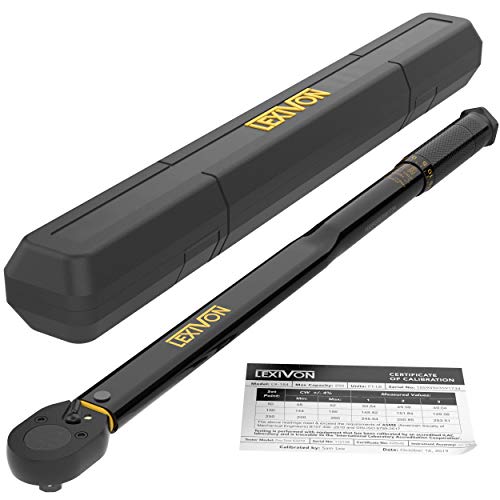
LEXIVON 1/2 inch Drive Click Torque Wrench, 25 to 250 ft-lb
$69.97Reaches 250 ft-lb, which is what a 2-5/16 inch hitch ball nut needs in addition to lug nuts.
Best for: Torquing a 2-5/16 inch ball nut as well as lug nuts.
Check price on AmazonHow we chose
We did not test this hardware in person and we never claim to. Picks are researched from manufacturer specification sheets, published towing standards, and the recurring themes in verified owner reviews. Every pick is matched to a real gross trailer weight rating, a real tongue or pin weight rating, a real receiver size or a real load index rather than to a price bracket, and it is placed in the tier where its published capability actually belongs. We rejected the unbranded flood that dominates the search results in several of these categories, because a weight distribution hitch, a brake controller, a trailer tire and a set of safety chains are all parts whose failure puts a loose trailer on a public road. Where a figure is towing convention rather than a published standard we label it that way, and where a manufacturer does not publish a figure we leave it out instead of estimating it.
Frequently asked questions
What torque should trailer lug nuts be set to?
It depends on your stud size and your axle manufacturer's own specification, which is the number that governs. Widely published typical ranges are 90 to 120 ft-lb for 1/2 inch studs, 120 to 140 ft-lb for 9/16 inch studs, and 140 to 160 ft-lb for 5/8 inch studs. Check the sticker on your axle or your trailer's documentation before trusting any generic chart, including this one.
Why do different sources give different trailer lug nut torque numbers?
Because torque depends on stud diameter, thread pitch, whether the threads are lubricated, and the specific wheel and hub design, and different axle manufacturers publish somewhat different figures even at the same nominal stud size. A universal number that ignored those differences would look confident and be wrong for some trailers, which is why this page publishes ranges by convention rather than one figure and tells you to check your own axle specification.
Why do trailer lug nuts need to be re-torqued after 50 miles?
Wheel mating surfaces, including the hub face and the tapered seats under the lug nuts, settle and bed in under the first miles of real driving load, which measurably reduces clamping force even on a wheel torqued correctly at installation. Every axle manufacturer publishes some version of this same 25 to 50 mile re-check instruction, and skipping it is one of the most common causes of a trailer wheel coming loose entirely.
What is the star pattern for tightening lug nuts?
It means alternating across the wheel rather than moving to the next adjacent nut, so on a 5-lug wheel the order is roughly 1, 3, 5, 2, 4 rather than going around the circle in numerical order. Combined with tightening in two or three stages rather than fully torquing one nut before touching the others, this seats the wheel evenly against the hub and avoids warping the wheel or the brake drum behind it.
Is it safe to use an impact wrench to torque trailer lug nuts?
An impact wrench is fine for the initial snug pass, but the final torque should always be set with a calibrated torque wrench, since an impact wrench cannot reliably stop at a precise foot-pound value the way a click-style or digital torque wrench does. Over-tightening with an impact wrench alone is a common way to stretch a stud past its elastic limit, which weakens it permanently even if the wheel does not fail immediately.
What happens if trailer lug nuts are under-torqued?
An under-torqued wheel does not clamp tightly enough to stay seated against the hub under the cyclic load of driving, so it works progressively looser with every mile rather than staying put. The lug holes elongate, the nuts back off further, and eventually the wheel can separate entirely. This is exactly why the mandatory 50 mile re-check exists: it catches a wheel that was under-torqued, or that has bedded in and loosened, before it becomes a road hazard.
Free download
Get the complete tow rig setups emailed to you
Both ladders, conventional travel trailer and fifth wheel, at beginner, intermediate and expert budgets, every item priced and linked with a running total, plus a printable pre-trip weighing worksheet you can fill in at the scale.
One email with the setups. No sequence, no sharing your address, unsubscribe any time.
Researched, not professional advice. This page is compiled from published standards, manufacturer towing guides and product specifications, and owner-review consensus, not hands-on testing. Figures described as a rule of thumb are towing convention rather than published standards, and they are labelled that way wherever they appear. Nothing here overrides your own ratings. Work your payload sum before your tow rating, because payload is the limit that actually binds on most half ton trucks and nearly every SUV. Load a conventional trailer to 10 to 15 percent tongue weight and a fifth wheel to 15 to 25 percent pin weight, and never lighter: a tail heavy trailer is what starts sway. Weigh the rig loaded rather than trusting a brochure dry weight. A weight distribution hitch and a set of air bags both restore ride height and control, and neither one raises a single rating. Trailer brakes are required by state law above a threshold that varies by state, and a breakaway battery that has quietly gone flat is the normal condition of most trailers on the road.