Gooseneck hitches
Which gooseneck hitch fits your truck and your trailer?
A gooseneck hitch is a ball mounted in the truck bed, over or just ahead of the rear axle, that a trailer's coupler drops onto and latches around. It carries a heavy equipment, livestock or flatbed trailer in a completely different way from a receiver hitch: the load presses down where the truck carries weight best rather than hanging off the back bumper, which is the same geometry a fifth wheel uses and the reason gooseneck trailers tow noticeably more stably than a bumper pull of similar weight.
How you install the ball depends entirely on what your truck already has. A truck with a factory puck system or a factory gooseneck prep hole takes a simple conversion kit with no drilling. A truck with neither needs a full under-bed hitch bolted to the frame, which is a real install but works on a truck that never came with any towing prep at all.
Treat a gooseneck trailer's tongue weight with the same respect you would give a fifth wheel's pin weight. It is not published as a single national figure, but the same 15 to 25 percent convention that governs a fifth wheel applies here for the same structural reason, the coupling sits over the axle, and that weight comes directly out of the truck's payload with no weight distribution hitch able to move any of it.
On this page
- Beginner: already have pucks? Start here
- Intermediate: a factory prep hole, done properly
- Expert: a full hitch on a truck with no prep at all
- How is a gooseneck hitch different from a fifth wheel hitch?
- How much tongue weight does a gooseneck trailer put on the truck?
- Towing a fifth wheel with a gooseneck-equipped truck
- Which trailers actually use a gooseneck coupling?
Beginner: already have pucks? Start here
If your truck has a factory puck system, this is the cheapest and simplest path to a gooseneck ball.

CURT 60639 OEM Puck Gooseneck Hitch Kit
$204.63A drop-in ball that installs into an existing puck system with a quarter-turn latch and retention balls, rated for 38,000 lb GTW and 9,500 lb of vertical load in the manufacturer's own listing, with no tools required.
Best for: A puck-equipped Chevrolet, Ford, GMC or Nissan truck that needs a gooseneck ball rather than a fifth wheel head.
Check price on AmazonIntermediate: a factory prep hole, done properly
For a truck with the factory gooseneck prep hole rather than a puck system, this is the correct OEM-style kit.
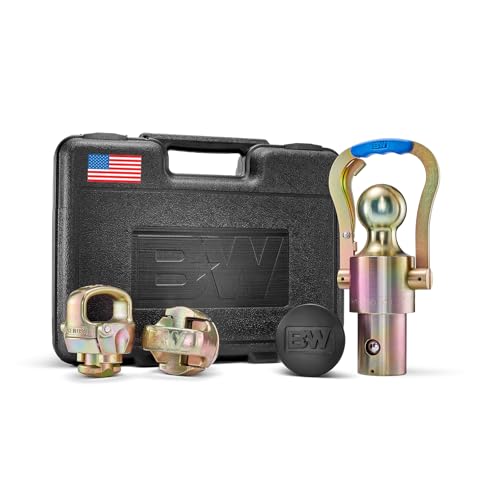
B&W OEM Gooseneck Ball and Safety Chain Kit for Ford, GM and Nissan
$299.00Drops into the factory prep hole on Ford, GM and Nissan trucks with the safety chain anchors included, so there is no under-bed install at all, and the handle locks horizontally to prevent an accidental unlatch.
Best for: A truck with a factory gooseneck prep hole rather than a full puck system.
Check price on AmazonExpert: a full hitch on a truck with no prep at all

B&W Turnoverball Gooseneck Hitch for Chevrolet and GMC 2500 and 3500
$694.88A complete under-bed, no-drill bolt-on gooseneck hitch for trucks with no factory puck or prep hole at all, with a ball that flips over and drops flush so the bed is flat when nothing is hitched.
Best for: A truck with zero factory towing prep that still needs a proper gooseneck ball.
Check price on AmazonWho should not buy this tier: A truck that already has a factory puck system or prep hole. Buying a full under-bed hitch when a $200 to $300 OEM kit already bolts straight into the existing holes is paying for hardware, and an install, that you do not need.
How is a gooseneck hitch different from a fifth wheel hitch?
A gooseneck ball couples to a trailer's own ball coupler; a fifth wheel jaw clamps around a kingpin, and the two are not interchangeable without an adapter.
Published standard A published, traceable figure: a standards body, a federal regulation or a manufacturer specification states it.
| Gooseneck | Fifth wheel | |
|---|---|---|
| Connection type | 2-5/16 inch ball and coupler | Kingpin and jaw |
| Typical trailer types | Livestock, equipment, flatbed | Travel trailer, toy hauler |
| Mounting position | In-bed, over the rear axle | In-bed, over or ahead of the rear axle |
| Needs sway control? | No | No |
How much tongue weight does a gooseneck trailer put on the truck?
Whatever that figure works out to, it comes straight out of your truck's payload, exactly the way a fifth wheel's pin weight does. Check the yellow payload sticker in your driver door jamb and the rear axle GAWR before buying a bigger trailer than the ball, not just the hitch, can actually support.
The convention band
Rule of thumbtongue weight = trailer weight x roughly 15 to 25 percent Example at 10,000 lb: 15% = 1,500 lb 20% = 2,000 lb 25% = 2,500 lb
This mirrors the fifth wheel band for the same structural reason: the load sits over the axle rather than hanging behind it. It is towing convention rather than a single published figure, and your trailer certification label is the authority for your own trailer.
Towing a fifth wheel with a gooseneck-equipped truck
Some owners end up with the opposite pairing: a truck already set up for a gooseneck ball, and a fifth wheel trailer with a kingpin that expects a jawed hitch. Rather than adding a second under-bed hitch, an adapter such as CURT's Spyder fifth wheel to gooseneck adapter lets the fifth wheel's kingpin latch onto the existing gooseneck ball, rated to 25,000 lb on industry standard rails. It is worth checking the trailer manufacturer's own position on this before buying, because an adapter concentrates the pin load into a single ball rather than spreading it across a full fifth wheel head, and some RV makers will not honor a frame warranty towed this way.
Which trailers actually use a gooseneck coupling?
Livestock trailers, flatbed and deckover equipment trailers, and heavy car haulers overwhelmingly use a gooseneck ball rather than a bumper pull receiver or a fifth wheel kingpin, because the working weights involved, often well into five figures, need the axle-over geometry to stay stable and to keep steering feel intact. A backhoe or a set of horses riding directly over the truck's strongest point behaves very differently from the same weight hanging off a rear bumper.
How we chose
We did not test this hardware in person and we never claim to. Picks are researched from manufacturer specification sheets, published towing standards, and the recurring themes in verified owner reviews. Every pick is matched to a real gross trailer weight rating, a real tongue or pin weight rating, a real receiver size or a real load index rather than to a price bracket, and it is placed in the tier where its published capability actually belongs. We rejected the unbranded flood that dominates the search results in several of these categories, because a weight distribution hitch, a brake controller, a trailer tire and a set of safety chains are all parts whose failure puts a loose trailer on a public road. Where a figure is towing convention rather than a published standard we label it that way, and where a manufacturer does not publish a figure we leave it out instead of estimating it.
Frequently asked questions
What is a gooseneck hitch, and what does it tow?
A gooseneck hitch is a ball mounted in the truck bed over the rear axle, and it couples to a trailer with a matching ball coupler rather than a kingpin. Livestock trailers, equipment trailers and flatbed trailers commonly use this connection because it distributes weight over the axle the same way a fifth wheel does.
Do I need a puck system to install a gooseneck ball?
No. A puck system is the easiest path if your truck already has one, but a factory prep hole works just as well with the right kit, and a truck with neither can still get a gooseneck ball through a full under-bed hitch bolted to the frame, which is a real install rather than a bolt-on kit.
Is a gooseneck hitch stronger than a receiver hitch?
Generally yes, because the load sits directly over the axle rather than hanging off a receiver behind the bumper. The hitches on this page range up to 38,000 lb GTW, well beyond what any receiver-mounted hitch on this site is rated for, which is why heavy equipment and livestock trailers are built around this connection.
Do I need sway control or a weight distribution hitch for a gooseneck trailer?
No. The same geometry that makes fifth wheels stable without weight distribution applies to gooseneck trailers: the connection sits over the rear axle instead of behind it, so there is very little to sway and nothing for a weight distribution hitch to redistribute. Payload is still the limit that matters.
Can I use my fifth wheel rails for a gooseneck ball?
Yes, with the right adapter. A hitch such as CURT's fifth wheel rail gooseneck hitch bolts a gooseneck ball onto existing fifth wheel base rails, which lets one set of rails serve both trailer types rather than requiring two separate under-bed installations for a truck that tows both.
How much tongue weight will a gooseneck trailer put on my payload?
Roughly 15 to 25 percent of the loaded trailer weight, the same convention band that governs a fifth wheel's pin weight and for the same structural reason. On a 10,000 lb equipment trailer that works out to 1,500 to 2,500 lb, and all of it comes out of your truck's payload rating.
Free download
Get the complete tow rig setups emailed to you
Both ladders, conventional travel trailer and fifth wheel, at beginner, intermediate and expert budgets, every item priced and linked with a running total, plus a printable pre-trip weighing worksheet you can fill in at the scale.
One email with the setups. No sequence, no sharing your address, unsubscribe any time.
Researched, not professional advice. This page is compiled from published standards, manufacturer towing guides and product specifications, and owner-review consensus, not hands-on testing. Figures described as a rule of thumb are towing convention rather than published standards, and they are labelled that way wherever they appear. Nothing here overrides your own ratings. Work your payload sum before your tow rating, because payload is the limit that actually binds on most half ton trucks and nearly every SUV. Load a conventional trailer to 10 to 15 percent tongue weight and a fifth wheel to 15 to 25 percent pin weight, and never lighter: a tail heavy trailer is what starts sway. Weigh the rig loaded rather than trusting a brochure dry weight. A weight distribution hitch and a set of air bags both restore ride height and control, and neither one raises a single rating. Trailer brakes are required by state law above a threshold that varies by state, and a breakaway battery that has quietly gone flat is the normal condition of most trailers on the road.