Trailers around 4,500 lb
How much tongue weight should a 4,500 lb trailer have?
Tongue weight is the downward force the coupler puts on the ball, and it is the single number that decides whether a trailer tracks or starts to sway. At 4,500 lb loaded, the conventional band puts it between 450 lb and 675 lb.
Err toward the heavy half of that band. A trailer is a pendulum hinged at the ball, and loading weight behind the trailer axle moves the trailer centre of mass rearward, lengthening the pendulum and reducing tongue weight at the same time. Once that happens, a gust or a passing truck starts an oscillation the trailer has almost nothing to damp, and it grows rather than dying out. Too much tongue weight overloads the tow vehicle rear axle and lightens the steering, which is a real problem, but it does not feed on itself.
At 4,500 lb you are into the range where a weight distribution hitch is conventionally called for, because the tongue weight is enough to noticeably lift the steer axle.
On this page
What is 10 to 15 percent of 4,500 lb?
The working
Rule of thumbtongue weight = trailer weight x percentage 10% of 4,500 lb = 450 lb 13% of 4,500 lb = 585 lb 15% of 4,500 lb = 675 lb
The percentage is measured against the trailer as it is actually loaded, with water, propane, batteries and everything you packed. A dry weight from a brochure gives you the wrong answer in the wrong direction.
Read across for the percentage you are aiming at. The 10 to 15 percent band is towing convention rather than a published standard, which is why it is labelled that way here.
A 4,500 lb trailer at 12 percent carries 540 lb on the ball, and at 15 percent it carries 675 lb.
Rule of thumb Widely taught towing convention rather than a published specification. It is a good starting point and it is not a rating.
| Percentage of trailer weight | Tongue weight | What it means |
|---|---|---|
| 8% | 360 lb | Too light, this is the sway condition |
| 10% | 450 lb | Inside the conventional band |
| 11% | 495 lb | Inside the conventional band |
| 12% | 540 lb | Inside the conventional band |
| 13% | 585 lb | Inside the conventional band |
| 14% | 630 lb | Inside the conventional band |
| 15% | 675 lb | Inside the conventional band |
| 18% | 810 lb | Heavy, check rear axle and payload |
The 10 to 15 percent band is taught by every trailer maker, every hitch maker and every towing school, and no standards body publishes it. Treat it as a target, and treat the ratings on your own hitch, receiver and axle as the limits.
What does that cost you in payload?
This is the sum that catches people out. Tongue weight is not carried by the trailer, it is carried by the tow vehicle, and it comes out of the payload printed on the yellow sticker in your door jamb along with everything and everybody else in the truck.
At 13 percent, the tongue weight alone is 585 lb, and a typical loaded tow vehicle adds up to roughly 1,373 lb once passengers and gear are counted.
Rule of thumb Widely taught towing convention rather than a published specification. It is a good starting point and it is not a rating.
| What is on the tow vehicle | Weight |
|---|---|
| Tongue weight at 13 percent | 585 lb |
| Weight distribution hitch hardware | 100 lb |
| Two adults in the cab | 360 lb |
| Two children | 160 lb |
| A full bed toolbox | 120 lb |
| A 2000 watt generator | 48 lb |
| Total out of payload | 1,373 lb |
Passenger and gear weights here are typical figures for illustration. Your own payload rating is the only number that matters, and it is on the door jamb, not in a brochure.
Which hitch class does that need?
Hitch classes are defined by the industry and the receiver opening size is standard, but the rating on your own receiver governs and it is frequently lower than the class ceiling, because the vehicle it is bolted to is the real limit.
A 4,500 lb trailer with 585 lb of tongue weight fits a Class III receiver used as a dead weight hitch.
Published standard A published, traceable figure: a standards body, a federal regulation or a manufacturer specification states it.
| Class | Receiver opening | Max trailer weight | Max tongue weight | With weight distribution |
|---|---|---|---|---|
| Class I | 1-1/4 in | 2,000 lb | 200 lb | no weight distributing rating |
| Class II | 1-1/4 in | 3,500 lb | 350 lb | no weight distributing rating |
| Class III | 2 in | 8,000 lb | 800 lb | 12,000 lb / 1,200 lb tongue |
| Class IV | 2 in | 10,000 lb | 1,000 lb | 14,000 lb / 1,400 lb tongue |
| Class V | 2-1/2 in | 17,000 lb | 1,700 lb | 20,000 lb / 2,000 lb tongue |
A weight distribution hitch does not confer the higher rating. That higher figure is a property of the RECEIVER, published by whoever made it, and only some receivers carry one.
Do you need a weight distribution hitch at this weight?
At 4,500 lb you are below the roughly 5,000 lb point where weight distribution is conventionally called for. The other trigger is a tongue weight above about 10 percent of the TOW VEHICLE weight, so a 540 lb tongue weight behind a light SUV can still call for one even at this trailer weight.
A weight distribution hitch does not raise any capacity. It does not add payload, it does not raise the GVWR, it does not raise the GCWR and it does not raise an axle rating. What it does is move load that is sitting on the tow vehicle rear axle forward onto the steer axle and back onto the trailer axles, which restores steering feel, braking and headlight aim. A truck that sits level while overloaded is still overloaded, and so is a truck with air bags in the rear springs.
Spring bars are rated by TONGUE WEIGHT, and the rating should bracket the weighed figure including anything bolted to the A-frame: propane cylinders, batteries, a generator, a bike rack. For 540 lb of tongue weight that points at 600 lb bars, which covers 400 to 600 lb. Bars far too stiff for the load ride harshly and distribute badly; bars too light bottom out and cannot do the job at all.
How do you actually measure it?
- Load the trailer the way you will tow it. Water in the tanks, propane on the A-frame, batteries connected, everything packed where it will actually ride. A tongue weight measured on an empty trailer tells you nothing useful.
- Get the trailer level. On level ground, with the coupler at the height that makes the trailer FRAME level rather than wherever the jack happens to be.
- Put a tongue weight scale under the coupler. A 585 lb reading needs a scale rated well above that. Lower the coupler onto the scale and read it with the jack taking no load.
- Or use a public scale. Weigh the whole rig hitched, then unhitch and weigh the tow vehicle alone at the same scale. The difference is the tongue weight, and this also gives you your real loaded trailer weight, which is the number this whole page depends on.
- Fix it by moving cargo, not by adjusting the hitch. Tongue weight comes from where the load sits relative to the trailer axle. Moving heavy items ahead of the axle raises it; moving them behind lowers it. No hitch adjustment changes where the trailer centre of mass is.
- Re-weigh after any real change. A new battery bank, a full water tank instead of an empty one, a generator in the front box: each one moves the number, and several of them move it a long way.
Gear for a 4,500 lb trailer
Chosen against the numbers on this page rather than from a general list, so the recommendation cannot contradict the arithmetic above. Every rating quoted is the manufacturer figure, and the rating on the part you receive is what governs.

Sherline LM 2000 Trailer Tongue Weight Scale, 2,000 lb
$189.90Double the capacity for the same money as the LM 1000, which makes it the sensible default unless you are certain your tongue weight is low.
Best for: Most travel trailers, with headroom for a heavier one later.
Check price on Amazon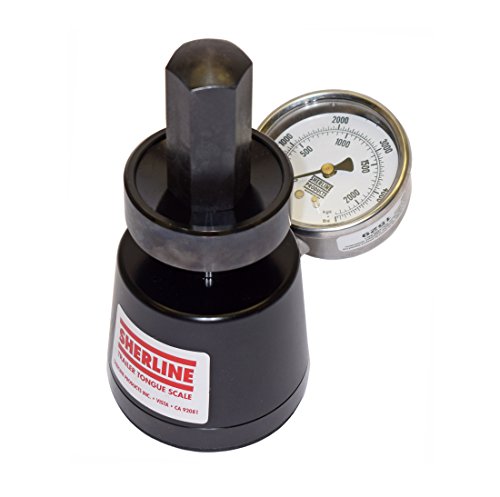
Sherline LM-5000 Trailer Tongue Weight Scale, 5,000 lb
$189.90Five thousand pounds, which is what it takes to weigh a fifth wheel pin rather than a bumper pull tongue.
Best for: Weighing fifth wheel pin weight at home.
Check price on Amazon
Sherline Hydraulic Tongue Weight Scale, 0 to 5,000 lb with dual scale gauge
$199.95Reads in both pounds and kilograms on one gauge, at 5,000 lb capacity.
Best for: Pin weight, with a metric reading for anybody who wants it.
Check price on Amazon
Sherline Hydraulic Tongue Weight Scale Combo with 2,000 lb and 5,000 lb Gauges
$229.95Two gauges on one scale body, so a 400 lb tongue weight can be read on the 2,000 lb gauge where the resolution is useful rather than squinted at on the 5,000 lb one.
Best for: Somebody weighing both a light trailer and a heavy one.
Check price on Amazon
B&W Digital Tongue Weight Scale
$149.00A digital readout rather than a dial, which removes the parallax error that makes a hydraulic gauge hard to read accurately when it is sitting on the ground under a trailer tongue.
Best for: Reading a figure precisely without lying on the driveway.
Check price on Amazon
B&W Tow & Stow Adjustable Ball Mount, 2-1/2 inch receiver, dual ball
$309.00 Published ratingsAdjustable for height and it stows out of the way when nothing is hitched, which is the single best answer to barking your shin on a ball mount. Two ball sizes on one head, flipped rather than swapped.
Best for: A truck that tows more than one trailer with different coupler sizes.
Check price on AmazonHow we chose
We did not test this hardware in person and we never claim to. Picks are researched from manufacturer specification sheets, published towing standards, and the recurring themes in verified owner reviews. Every pick is matched to a real gross trailer weight rating, a real tongue or pin weight rating, a real receiver size or a real load index rather than to a price bracket, and it is placed in the tier where its published capability actually belongs. We rejected the unbranded flood that dominates the search results in several of these categories, because a weight distribution hitch, a brake controller, a trailer tire and a set of safety chains are all parts whose failure puts a loose trailer on a public road. Where a figure is towing convention rather than a published standard we label it that way, and where a manufacturer does not publish a figure we leave it out instead of estimating it.
Frequently asked questions
What is 10 percent of a 4,500 lb trailer?
Ten percent of 4,500 lb is 450 lb, and that is the FLOOR of the conventional tongue weight band rather than the target. Aim higher, around 540 to 585 lb, because a trailer loaded to exactly the minimum has no margin: shifting cargo rearward during a trip, or filling a rear mounted water tank, can drop it below the floor without you noticing.
Is 675 lb too much tongue weight on a 4,500 lb trailer?
At 675 lb you are at 15 percent, the top of the conventional band, which is acceptable for the trailer and demanding on the tow vehicle. Check two things: the rear axle GAWR on the door jamb sticker, and the payload remaining after passengers and cargo. Too much tongue weight lightens the steer axle, which a weight distribution hitch corrects, and consumes payload, which nothing corrects.
Why is too little tongue weight more dangerous than too much?
Because it self-amplifies. A trailer pivots at the ball like a pendulum, and a tail-heavy load moves its centre of mass rearward, which both lengthens that pendulum and reduces the tongue weight holding it steady. A small yaw input then grows into a larger one instead of damping out. Too much tongue weight overloads axles and lightens steering, which are serious but stable failures.
Does a weight distribution hitch let me tow more than 4,500 lb?
No. A weight distribution hitch moves load between axles, it does not create capacity. It cannot raise your payload, your GVWR, your GCWR or any axle rating. Some receivers carry a higher weight-distributing rating published by their maker, and that higher number belongs to the receiver rather than to the hitch. Your door jamb sticker and owner manual still govern everything.
Can I use the brochure dry weight instead of weighing it?
No, and this is the most common expensive mistake in towing. A brochure dry weight excludes dealer-installed options, batteries, propane and every drop of water. A 50 gallon fresh tank alone is 417 lb. Trailers routinely weigh well over a thousand pounds more loaded than the brochure figure, and the tongue weight moves with it. Weigh the rig.
Do propane cylinders and batteries count?
They count twice over, because they sit on the A-frame ahead of the trailer axle, which is the highest leverage position on the whole trailer. Two full 20 lb cylinders are about 74 lb and a group 24 battery is about 50 lb, so nearly 124 lb lands almost entirely on the tongue. Adding a second battery is a real tongue weight change.
Free download
Get the complete tow rig setups emailed to you
Both ladders, conventional travel trailer and fifth wheel, at beginner, intermediate and expert budgets, every item priced and linked with a running total, plus a printable pre-trip weighing worksheet you can fill in at the scale.
One email with the setups. No sequence, no sharing your address, unsubscribe any time.
Researched, not professional advice. This page is compiled from published standards, manufacturer towing guides and product specifications, and owner-review consensus, not hands-on testing. Figures described as a rule of thumb are towing convention rather than published standards, and they are labelled that way wherever they appear. Nothing here overrides your own ratings. Work your payload sum before your tow rating, because payload is the limit that actually binds on most half ton trucks and nearly every SUV. Load a conventional trailer to 10 to 15 percent tongue weight and a fifth wheel to 15 to 25 percent pin weight, and never lighter: a tail heavy trailer is what starts sway. Weigh the rig loaded rather than trusting a brochure dry weight. A weight distribution hitch and a set of air bags both restore ride height and control, and neither one raises a single rating. Trailer brakes are required by state law above a threshold that varies by state, and a breakaway battery that has quietly gone flat is the normal condition of most trailers on the road.